
- Published on June 17, 2026
July Weekend Courses
Taught in the beautiful setting of Madingley Hall, our Weekend Courses offer you the opportunity to discover new subjects, learn from some of our finest academics, expand your professional and social networks and become part of a supportive learning community.
You can book to stay in the comfortable rooms at Madingley Hall, with views over the woods, gardens and courtyard. Each en-suite room has wi-fi, TV, phone, and tea- and coffee-making facilities. Breakfast is also included.
If you choose to stay nearby, no problem. You’ll still be able to enjoy the grounds during the day and enjoy the award-winning cuisine in our elegant dining hall.
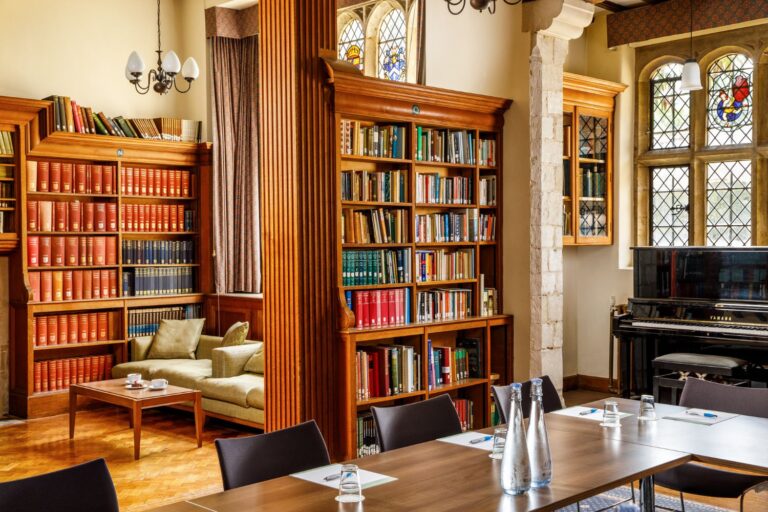
The following courses will run from 03 – 05 July 2026:
Small wonders: an introduction to writing short fiction
A short course for short fiction – we’ll explore the ‘moment glimpsed in passing’ that is the short story. This is the realm of the fleeting, the love affair that can’t last, the overheard conversation, so we’ll be looking at how we actually pin down these glimpsed moments and considering what really makes a short story ‘short’ (it’s not just about word count!) Through discussion of exemplar texts and practical writing exercises aimed at developing specific elements of the writer’s craft, we will explore the way short fiction works and consider its very particular way of rendering our experience of the world.
Tutor – Dr Lucy Durneen. Teaching Associate for Creative Writing
Philosophy, humour and the absurd
Humour is important to most of us and yet philosophers have, historically, refused to take humour seriously. More recently, however, several philosophical theories of humour have developed to try to explain why humour does not simply make us laugh, it also makes us think. The course seeks to redress the apparent tensions that exist between humour and Philosophy. We will explore the limited, historical material relating to the Philosophy of humour, including insights from Rene Descartes, Immanuel Kant, Henri Bergson and Ludwig Wittgenstein. We will assess historical and contemporary theories of what humour consists in. Later discussions will revolve around questions of how humour informs existential questions of how one ought to live.
Tutor – Dr Alex David Carter. University of Cambridge Professional and Continuing Education (PACE) Associate Professor and Academic Director for Philosophy and Interdisciplinary Studies; -Fellow Fitzwilliam College, Cambridge
Divided kingdom: social class and inequality in modern Britain
All complex societies are characterised by the unequal distribution of resources. In this course, we will take a fresh look at the extent to which Britain is united or divided in the early 21st century by exploring social class, ethnic and gender inequalities. We will consider definitions of social class and its impact on life chances, and will evaluate theories of inequality to explore the issue of social justice.
Tutor – Dr Nigel Kettley. Academic Director, University Associate Professor in Education and Social Science, University of Cambridge Professional and Continuing Education (PACE); Director of Studies in Education, Tutor and Fellow, Wolfson College
21st-century stories: the short story now
This course will examine innovations and experiments in recent literary short stories and think about how writers are reinventing the form for the 21st century. Authors will include Percival Everett, Ali Smith, Sarah Hall and Jamil Jan Kochai, among others, and our stories will cover a range of genres from metafiction to science-fiction.
Tutor – Dr Jenny Bavidge. Academic Director, University Senior Lecturer in English Literature, University of Cambridge Professional and Continuing Education (PACE)
Our Student Stories
I work on the use of history in interaction with the metaphorical ‘other’ and more specifically the reception of historical cultures. Civic integration courses are my main area of research. The weekend course I followed closely fits in my professional aim to understand the role of history in identity processes and feeling of belonging. Understanding the past of Middle East is important here to get an understanding of the collective memory/historical culture that newcomers in Europe born in that region carry with them.
Newly arrived in the United Kingdom from Canada as a military family, it was a dream-come-true for me to discover a Cambridge University PACE Writer's Retreat at the stately Madingley Hall. With a debut novel published last year, I yearned to meet fellow writers during my time abroad and forge community. This past weekend surpassed my expectations. Friendships, laughter, mentor-led work-sopping, long walks, breaking bread together, and lasting memories are the legacy of the weekend
I attended this course to explore the study of English literature in the setting of Cambridge University. I had previously taken degrees in history and law but regretted not studying English literature at university despite enjoying it at the A level stage. It was also an opportunity to step way from my normal routines and meet new people. The combination of excellent tuition, accommodation and interaction with other students during the Fairy Tales course at Madingley Hall has encouraged me to enrol for further such courses in future.
Attending the courses at PACE gave me the chance to step out of the mundane and into possibility. The possibility to be me, away from the daily routines and pressures of life; to meet diverse groups of people with one shared aspiration: to keep learning. Being at PACE gave me access to teachers of exceptional quality and the chance to let my mind learn again: bliss! To be refreshed by the minds of fellow learners in the context of the beautiful Madingley was so very precious to me. Thank you to all, particularly the organisers who ran the perfectly oiled machine, our generous teachers and the kitchens who prepared such great suppers on Fridays and Saturdays.
I love studying especially updating my knowledge in world affairs. I opted for the AI Course as I am very inquisitive about what AI can bring to the world as I have seen a drastic change in everyday life with the intervention of AI. Applications like Chat GPT, you put certain information and you can get all the knowledge from the globe. To be honest, I love being old school, this was the reason I became more curious to understand how AI works, the history, the theories it is based on, the concepts, the future we are looking at and so many factors. I would love to take more courses at University of Cambridge and keep updating my knowledge regarding various subjects.